
Planning
Planning farrier rounds: paper, Excel or software?
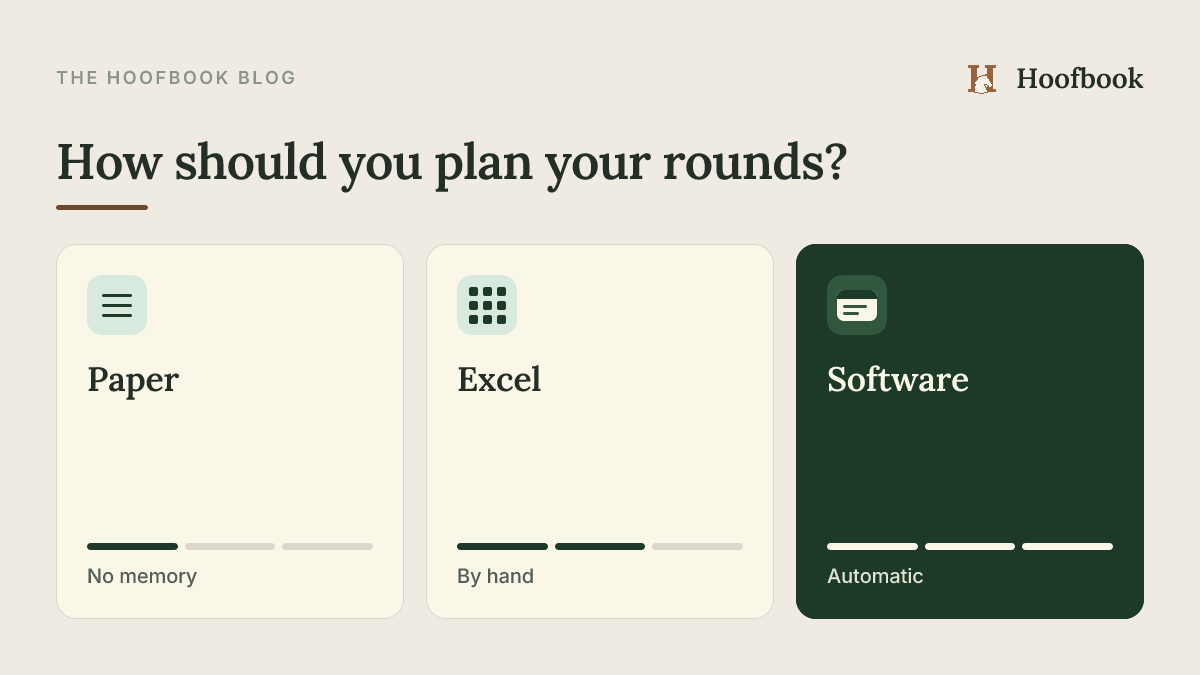
In short
Paper is quick for jotting a note, but planning a whole week still happens mostly in your head. A spreadsheet can be set up with a few automations you build yourself — but in the end, it's still you working out the order of stops and every figure that keeps shifting (fuel price, toll price, vehicle type, and so on). Software structures it all for you, without you even having to think about it (we've already done that part): it groups nearby stables, finds the best route, and prices each round in time, kilometres, fuel and tolls. A small, settled round: paper is fine. A wide area, or clients with their own quirks: software saves you so much time.
You already plan your rounds. The question isn’t whether, but with what. A notebook? A spreadsheet? Software?
Each method has its place. The right choice depends on the specifics of your own business. Here are the three, compared honestly.
The three methods, at a glance
Paper: quick notes on the fly, less so for planning. A spreadsheet keeps a record. Software does the maths for you. Here’s what each one does — and doesn’t.
| Criterion | Paper | Spreadsheet | Software |
|---|---|---|---|
| See the whole week at a glance | Yes | Yes | Yes |
| Group nearby stables | By hand | By hand | Automatic |
| Find the best order of stops | By hand | By hand | Automatic |
| Price kilometres, fuel and tolls | No | If you build it | Yes, per round |
| Recalculate when an appointment moves | Start over | Start over | Automatic |
| Give the client an arrival time | A guess | A guess | Calculated time |
| Usable on your phone, even with no signal | — | Awkward | Yes |
Paper: who does it still work for?
Paper looks unbeatable on two points: speed and reliability. An appointment to push back, a horse to see again next week — you scribble it down in two seconds, no screen, no battery, no app to open. But that speed is for the quick note. Not for replanning whole days, or a whole week.
Beyond the jottings, though — everything else is on you. The notebook keeps the record, granted; it doesn’t do the work for you. You’re the one sorting the order of stops, you’re the one catching the visit you forgot, you’re the one recalculating when an appointment shifts, you’re the one guessing what a detour cost you in fuel. All that sorting happens in your head, it takes time — and that’s where the method shows its limits.
Reliability? True, you could lose a paper diary just as easily — but we don’t know many farriers it actually happens to, do we? Maybe we should run an archive contest: the win goes to the professional with the tallest stack of old diaries.
A spreadsheet: a real step up, but how far?
Excel is already better: everything in one place, readable, sortable. You see your horses, your dates and your stables in a clear table.
But a spreadsheet analyses nothing — it’s still you doing it, by hand. The file knows neither the distances between your stables nor the tolls on the road. To price a round, it’s up to you to build the formula.
And a spreadsheet on your phone, at the edge of a field, stays awkward. Excel helps you note things down. It doesn’t help you turn a profit or work efficiently.
Software: what Hoofbook does
Software does for you everything you used to do in your head — and it does it in seconds. That’s exactly what Hoofbook does: it takes your planning habits and preferences into account, groups nearby stables on the same day, finds the best order of stops, and prices each round in time, kilometres, fuel and tolls. It works like a smart diary: every horse is scheduled, along with the time needed for each task you’ll carry out in each particular case. The day is already structured for you — and so is every other day. All that’s left is to set your alarm clock.
For your route, you get two modes: fastest (the least drive time) or cheapest (avoiding costly motorway sections when your route crosses them). You choose, day by day.
When an appointment moves, you drag the visit from one day to another, and the round reorganises around it. Hoofbook also works out a realistic arrival time for each stop — which you pass to the client so they’re ready. And on your phone, the day’s plan stays available even with no signal.
We walk through the method Hoofbook uses in our guide to planning your rounds to drive less.
How much does each method really cost?
Paper and a spreadsheet are “free”. But their real cost is often hidden from view: it sits in the time, and in the costs tied to your driving and your organising.
A week rarely hides just one detour. Say you avoid two of 30 km:
- Fuel: roughly €5 to €8 per avoided trip.
- Time: 30 to 45 minutes back, each time.
- Tolls: €5 to €15 on top, if your area runs along the motorway.
Over a month, those detours often weigh more than a Hoofbook subscription (€20 a month, or €211 a year, excluding VAT). The time and kilometres you save cover it quickly — but you’ll find that out soon enough for yourself.
So which should you choose?
We’ll let you think it over. As for us — we’ve got all the time in the world now that we’ve built a smart diary.
Want to see what it changes on your own rounds? Try Hoofbook: 30 days free, no credit card required.
Key takeaways
- Paper is instant, but all the organising work stays on your shoulders: you sort the horses by date, you set the order of stops, you recalculate when an appointment moves.
- A spreadsheet keeps a clear, sortable record — but you're still the one who has to set it up, and still the one working out every figure.
- Software structures it all for you: it groups and assesses nearby stables, fits your conditions and preferences, and works out the route — fastest or cheapest — in seconds.
- Choose by your area: small and with no moving parts, paper is fine; wide or changing, software saves you hours.
Frequently asked questions
- Is paper enough to manage a farrier's rounds?
- For a small, settled round you know by heart and that never changes, yes. Paper is instant and never breaks down. But all the organising work stays with you. As soon as your area widens — or your client list does — that time spent organising it all in your head gets expensive.
- Is Excel a good tool for planning rounds?
- A spreadsheet keeps a clear, sortable record of your horses and their due dates. It's a real step up from paper. But you still have to build all of it yourself: the spreadsheet knows neither the distances between your stables nor the cost of anything. It only helps if you put in all the setup time it needs — and if you're willing to go back into it at the slightest change.
- What does software do that paper and a spreadsheet don't?
- It structures your days for you. It automatically groups nearby stables on the same day, spots the connections between them, works out the best order of stops (fastest or cheapest), and prices each round in time, kilometres, fuel and tolls. When an appointment changes, it reorganises the round on its own, with nothing to redo by hand. And the day's plan stays available on your phone, even with no signal.
- How much does farrier software cost?
- Hoofbook costs €20 a month, or €211 a year, excluding VAT. The trial is free for 30 days, with no credit card required. Over a month, the kilometres — and above all the hours — you save comfortably cover the subscription.
- Should I switch methods if my rounds already work?
- Not necessarily. If your round is small with no moving parts at all, keep what works. Software earns its place when your client list keeps shifting — because of how the horses are worked, or your clients' own habits — when your area widens, when appointments move often, or when new clients keep dropping in and out of your usual loop.